Pre-Stained Cedar Panels vs. Site-Built Fences in HOA Neighborhoods
Pre-built cedar panels, site-built cedar, or cedar and hog wire? How each option fits HOA review in Kenmore, Seattle's north end and the Eastside, with the rules cited.

If you live in an HOA neighborhood, the way your fence is built matters almost as much as how it looks. Before choosing a style, it helps to know what the architectural committee will review and how each build method fits that review.
This guide compares pre-built (pre-fab) cedar panels, site-built cedar, and cedar-framed hog wire, with pre-staining as an option on any of them. It's written for HOA neighborhoods in Kenmore, Seattle's north end and the Eastside.
Quick note: We're SeattleFence, an independent fence contractor. We aren't affiliated with any HOA mentioned here. Only your association and your city can decide what's allowed on your lot.
On this page
- The three build options
- Side-by-side comparison
- Where pre-staining fits
- What HOA documents actually say
- City permit basics
- Putting together an approval package
- Related neighborhood guides
- Sources
The three build options
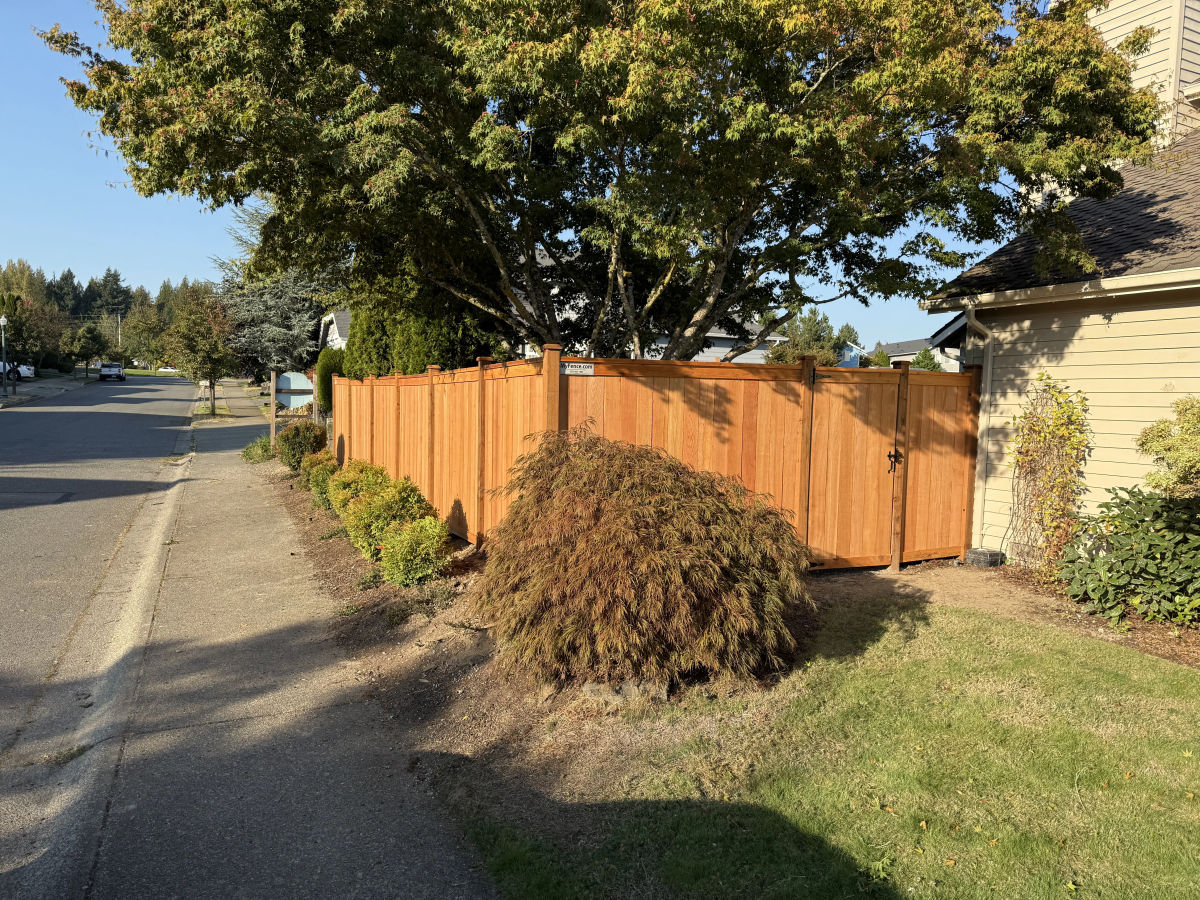
Pre-built (pre-fab) cedar panels
The fence sections are assembled before they reach your yard, then hung between posts set on site. Every section shares the same board spacing and trim, so long runs look uniform. Panels are easiest to use on fairly level ground with straight property lines.
Site-built cedar
Posts, rails and boards are put together in place on your lot. That gives the crew room to follow grade changes, work around trees and retaining walls, and match the height or detail of an existing fence. Styles like picture frame, 3-rail picture frame and horizontal cedar are often built this way.
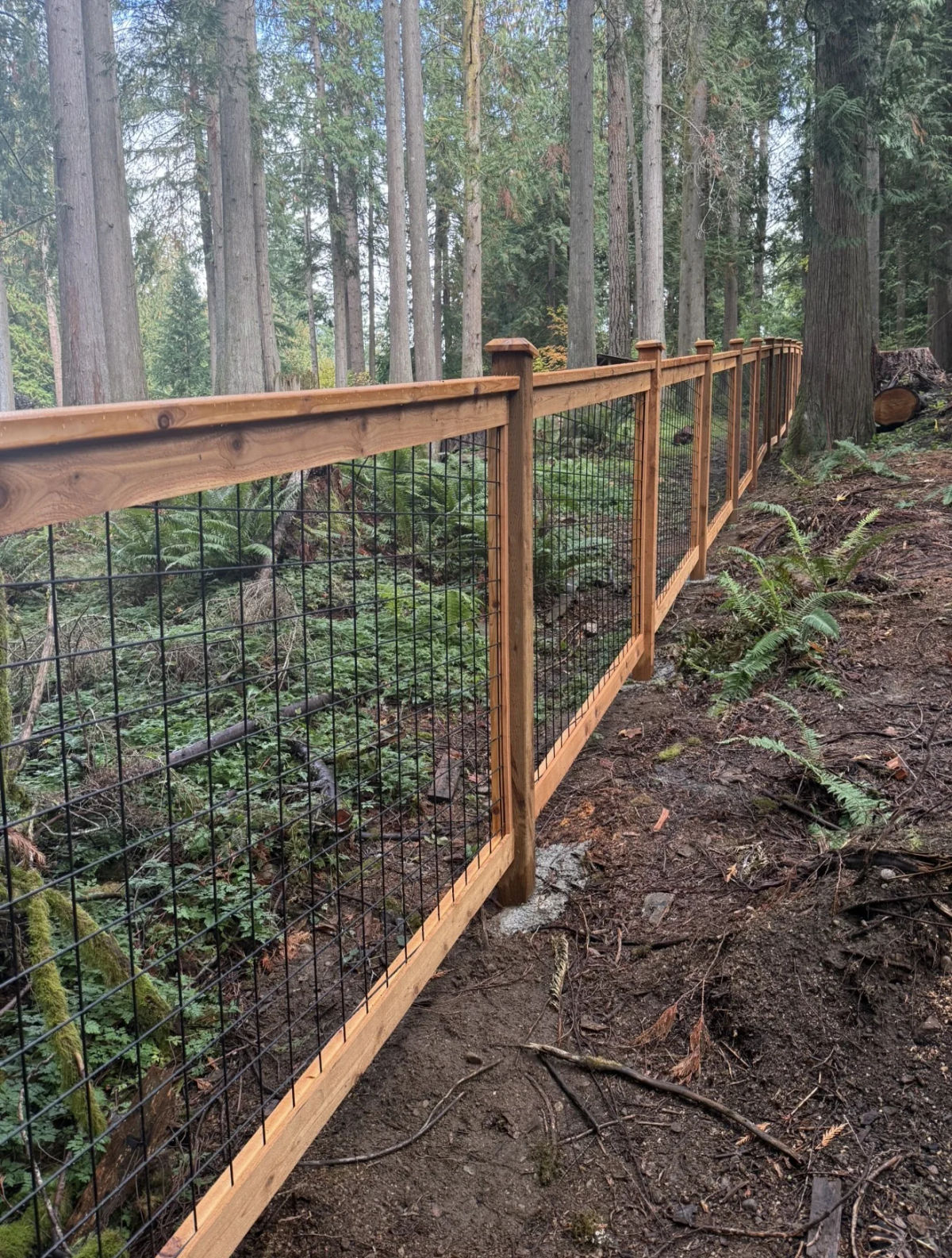
Cedar and hog wire
A cedar frame with welded wire infill keeps sightlines and light open. People often choose it along trails, gardens and view lots. See our 5 ft galvanized hog wire, 6 ft black hog wire and 3 ft black hog wire styles.
Side-by-side comparison
This table compares how each option usually plays out on a real lot. It doesn't compare prices, because cost depends on your site, and we quote every property individually.
| Factor | Pre-built cedar panels | Site-built cedar | Cedar and hog wire |
|---|---|---|---|
| Privacy | Full, with solid boards | Full, with solid boards | Open; light and views pass through |
| Sloped or uneven ground | Panels are stepped, which can leave gaps under each step | Easier to step or follow the grade | The frame can step; the wire infill is cut to fit |
| Matching an existing HOA fence | Works if the panel style matches | Easiest; details can be copied in place | Usually a different look from solid fences |
| Uniform look on long runs | Very consistent | Consistent with careful layout | Consistent |
| Neighbor outlook and views | Solid, so it blocks views at full height | Solid, so it blocks views at full height | Keeps views more open |
| What to include in an ACC request | Panel style, height, stain color, layout | Board style, height, stain color, layout and post spacing | Frame and wire details, height, color, layout |
Committees decide on looks, not build method. None of the HOA documents cited below prefers panels over site-built construction. They review what the fence will look like, how tall it is, what it's made of and where it goes.
Where pre-staining fits
Pre-staining means the cedar is stained before it's installed, so the boards are covered evenly and the fence goes in already protected. We offer pre-staining as an add-on for panels, site-built cedar and hog wire frames.
For HOA neighborhoods, the practical point is color. Several committees review color as part of the design, so pick the stain before you apply and include a sample with your request.
What HOA documents actually say
These are the rules we could verify in each association's own public documents. Rules change, so always read your current covenants.
Vineyard Crest, Kenmore
- Written approval first. The Vineyard Crest CC&Rs (Section 5.1.1) list fences and hedges among the Structures that need approval from the Board or the Architectural Control Committee (ACC). No work can start until the ACC gives written approval.
- 30-day review. Section 5.1.3 says to submit plans at least 30 days before you plan to start. If the ACC doesn't approve or disapprove within 30 days, it's deemed to have approved.
- In-kind work. The association's home page says in-kind maintenance, repair or replacement generally doesn't need a request. A change in color or style, or a new structure, does.
So switching from site-built cedar to a different-looking panel, or changing the stain color, counts as a change and should go to the ACC.
Lakemont Woods, Bellevue
- Fence limits. CC&R Section 5.2.3 says no fence may be over six feet tall, and no barbed wire, chain link or corrugated fiberglass fences may go on any lot.
- Committee approval. All fences, open and solid, must meet the Committee's standards and be approved before construction.
Read our Lakemont Woods HOA fence guide.
Innis Arden, Shoreline
The Innis Arden Club's 2026 Homeowner's Guideline lists fences and gates among changes that don't need Board approval. The exception is when their materials or height affect the outlook of neighboring properties, or don't meet Covenant requirements.
On view lots, an open cedar and hog wire design may be worth discussing with the club's Building and Remodel Committee early.
Talus, Issaquah
Issaquah Land Use Code 18.708.025 says that before submitting any permit in Talus, you must show Architectural Review Committee (ARC) approval where the ARC has purview, or show the ARC is inactive.
Rules aren't always published. Some associations don't post fence guidelines. In those cases, ask the committee directly and read your recorded covenants before you order materials.
City permit basics
- Kenmore: Municipal Code 15.30.205 exempts fences not over eight feet high from a building permit. The exemption doesn't apply in critical areas, shorelines, associated buffers or native growth protection areas such as tracts.
- Seattle:
- SDCI's fences page says you don't need a permit for a fence 8 feet high or less with no masonry or concrete elements over 6 feet. A fence in a flood-prone area does need one.
- In neighborhood residential and multifamily zones, the height limit is 6 feet, plus 2 feet of architectural features such as arbors or trellises.
- The limit is 4 feet in a front or street-side setback.
- Issaquah: the city's Decks and Fences page says residential fences need no building permit unless they're in a critical area or more than 6 feet tall. It notes HOA approvals may also be required.
No city permit doesn't mean no HOA review. Plan on both.
Putting together an approval package
Whatever build method you choose, a clear request moves faster. We help homeowners pull together:
- A site sketch showing the fence line, gates and any slope
- The style, whether pre-built panels, site-built cedar or cedar and hog wire
- The height, measured the way your city and HOA measure it
- The stain color, with a sample if the committee asks for one
- Notes on any shared fence, tract or easement nearby
Contact us for a free quote and a written scope you can attach to your HOA request. Call (253) 766-5854 or request a quote online.
Related neighborhood guides
- Lakemont Woods HOA fence guide (Bellevue)
- Norwood Village HOA fence guide (Bellevue)
- Blue Ridge Club fence guide (Seattle)
- Issaquah Highlands HOA fence guide
- Fence installation in Laurelhurst, Seattle
- Cedar privacy fences
- Seattle, Bellevue and Issaquah service areas
- All service areas
Sources
- Vineyard Crest CC&Rs (PDF), Sections 5.1.1 and 5.1.3, published on the Vineyard Crest HOA CC&Rs page
- Vineyard Crest HOA home page: ACC submissions and in-kind work
- Lakemont Woods CC&Rs (PDF), Section 5.2.3
- Innis Arden Club 2026 Homeowner's Guideline (PDF)
- Issaquah Land Use Code 18.708.025 (Talus)
- Kenmore Municipal Code 15.30.205
- Seattle SDCI: Fences
- City of Issaquah: Decks and Fences